
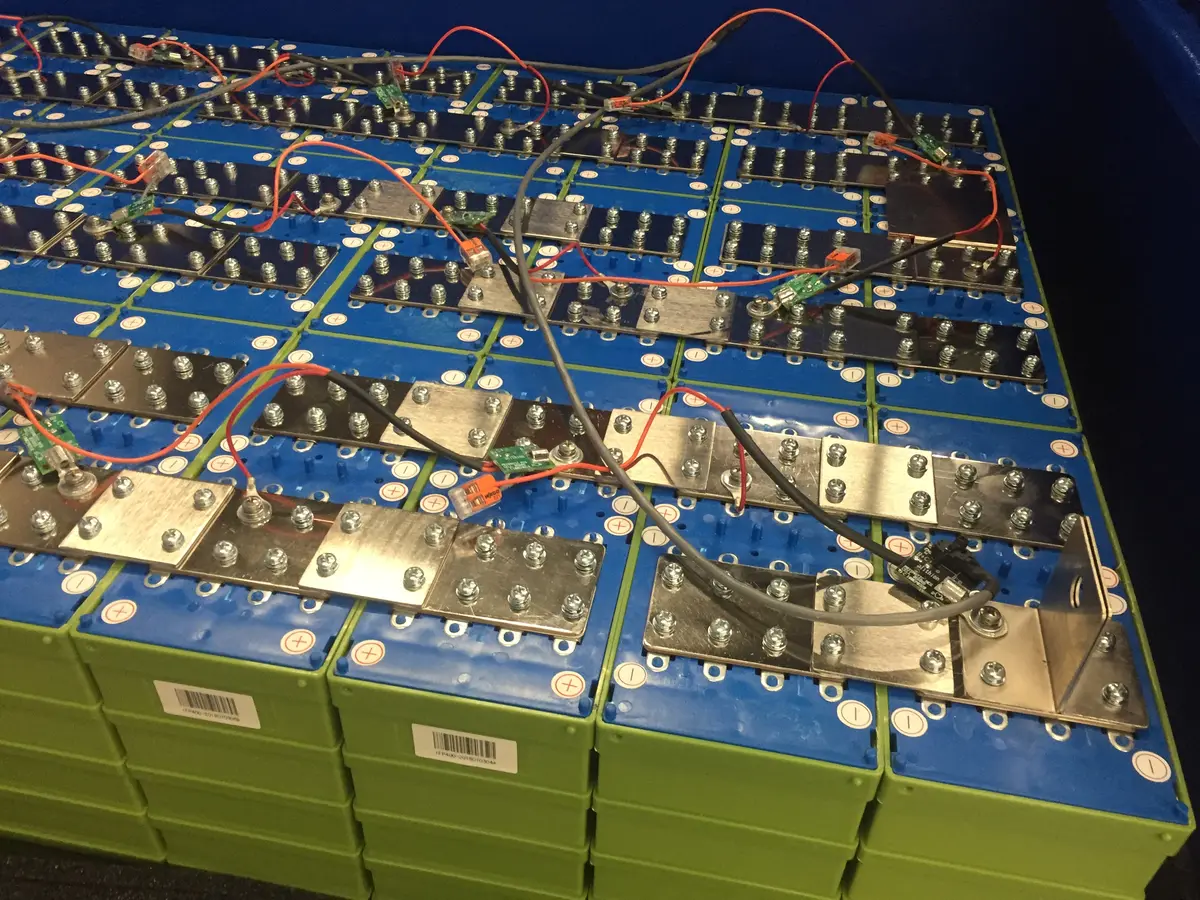
The battery bank is the heart of any off-grid or hybrid solar system – and usually its most expensive component. Two chemistries dominate the market today: lithium iron phosphate (LiFePO4) and sealed GEL deep-cycle lead-acid. Both work, but they fail differently, cost differently and suit different projects. This comparison is based on the systems we ship, from 5 kWh home banks in Lebanon to 200 kWh storage containers in Nigeria.
Cycle Life: The Fundamental Gap
A LiFePO4 cell routinely delivers 6,000 cycles at 80% depth of discharge, and our rack-mounted series is rated for 8,000. A quality GEL battery delivers around 1,000 cycles at 70% DOD before capacity falls to 80%. That is roughly a six-to-eight-fold difference in service life.
Cycle life translates directly into cost per kWh stored. Even where lithium costs two to three times more upfront, the cost per delivered kWh over its life is typically lower – often by half. For anyone cycling a battery daily, which is every off-grid and self-consumption system, this arithmetic dominates the decision.
Usable Capacity and Efficiency
Lead-acid batteries should not be discharged deeply if you want them to last: 50% DOD is the safe everyday figure for GEL. A nominal 2.4 kWh GEL block therefore gives you about 1.2 kWh of practical storage. LiFePO4 happily delivers 80-90% of its nameplate capacity, and our modules’ built-in battery management systems enforce the limits automatically.
Round-trip efficiency tells the same story. Lithium returns 90-95% of the energy you put in; lead-acid returns 80-85%, and that figure drops in cold weather. In solar systems where every watt-hour of sunshine is precious, lithium wastes noticeably less.
Temperature Behaviour
Both chemistries need care in heat. Lead-acid life halves roughly every 8-10°C above 25°C ambient – painful in desert projects. LiFePO4 tolerates heat far better, though extreme temperatures still stress the cells; our battery management systems monitor temperature and derate charging to protect the pack. In freezing conditions, lithium must not be charged below 0°C without heating, while GEL charges (slowly) fine. For our Mongolian wind-solar hybrid project, the insulated, heated battery room was a deliberate design choice for exactly this reason.
Maintenance and Practicality
GEL batteries are sealed and maintenance-free in the flooded-battery sense, but they are heavy, must sit upright, and voltage drifts between series-connected blocks require periodic equalization charging. LiFePO4 modules arrive with the balancing electronics built in, stack or rack in minutes, and monitor themselves – installers report commissioning time cut in half. Our wall-mounted 51.2V series hangs on a garage wall and takes up less space than the lead-acid bank it replaces.
Safety and Disposal
LiFePO4 is the safest lithium chemistry: the iron-phosphate cathode is far more thermally stable than the cobalt-based chemistries in consumer electronics, which is why it is the standard for stationary storage. GEL is inherently non-flammable and fully recyclable through established lead-acid channels – a genuine advantage in regions with mature lead recycling and weak lithium logistics.
Where Each One Makes Sense
Choose GEL when upfront capital is the binding constraint, the system cycles lightly (weekend cabins, backup-only installations), ambient temperatures are extreme and uncontrolled, or local recycling infrastructure favours lead-acid. Our 12V 200Ah GEL blocks remain a dependable, cost-effective choice for exactly these cases.
Choose LiFePO4 for anything that cycles daily: off-grid homes, telecom sites, C&I peak shaving and hybrid self-consumption. The higher initial investment repays through cycle life, usable capacity and eliminated maintenance – and the gap keeps narrowing as lithium prices fall.
Charging Behaviour and System Design
The chemistries also behave differently in daily operation. GEL batteries accept a limited charge current and need a full absorption stage to avoid stratification, so on short winter days a GEL bank may finish charging only on sunny afternoons. LiFePO4 accepts high charge rates – up to 1C on our modules – and has no absorption requirement, so even a brief clearing in the clouds pushes meaningful energy into the pack. This is why a 10 kWh lithium bank can out-deliver a nominally identical lead-acid bank in poor weather: it refills faster between clouds. When pairing batteries with charge controllers or hybrid inverters, confirm the charging profiles match; our MPPT controllers and hybrid inverters carry selectable profiles for both chemistries.
A Ten-Year Cost Example
Consider a 5 kWh-per-night off-grid home. A 10 kWh GEL bank costs less upfront but, at 1,000 cycles and 50% usable DOD, needs replacement roughly every four to five years – two replacements within a decade. A 10 kWh LiFePO4 wall-mounted bank costs more on day one but delivers 6,000+ cycles, covering the same duty for well beyond ten years with no replacements, no equalization charging and no acid checks. Add the higher round-trip efficiency saving solar array size, and lithium’s lifetime cost per stored kWh typically lands 30-50% below GEL. The crossover point moves with local prices, which is why we model both options for every serious enquiry.
The Bottom Line
Ask not “which battery is better” but “how many kWh will I cycle per day, for how many years, at what temperature.” Run those numbers and the choice usually makes itself. If you share your daily consumption and location, our engineers will size both options and show the lifetime cost comparison – so you buy the chemistry that fits your project, not the one with the loudest marketing.