
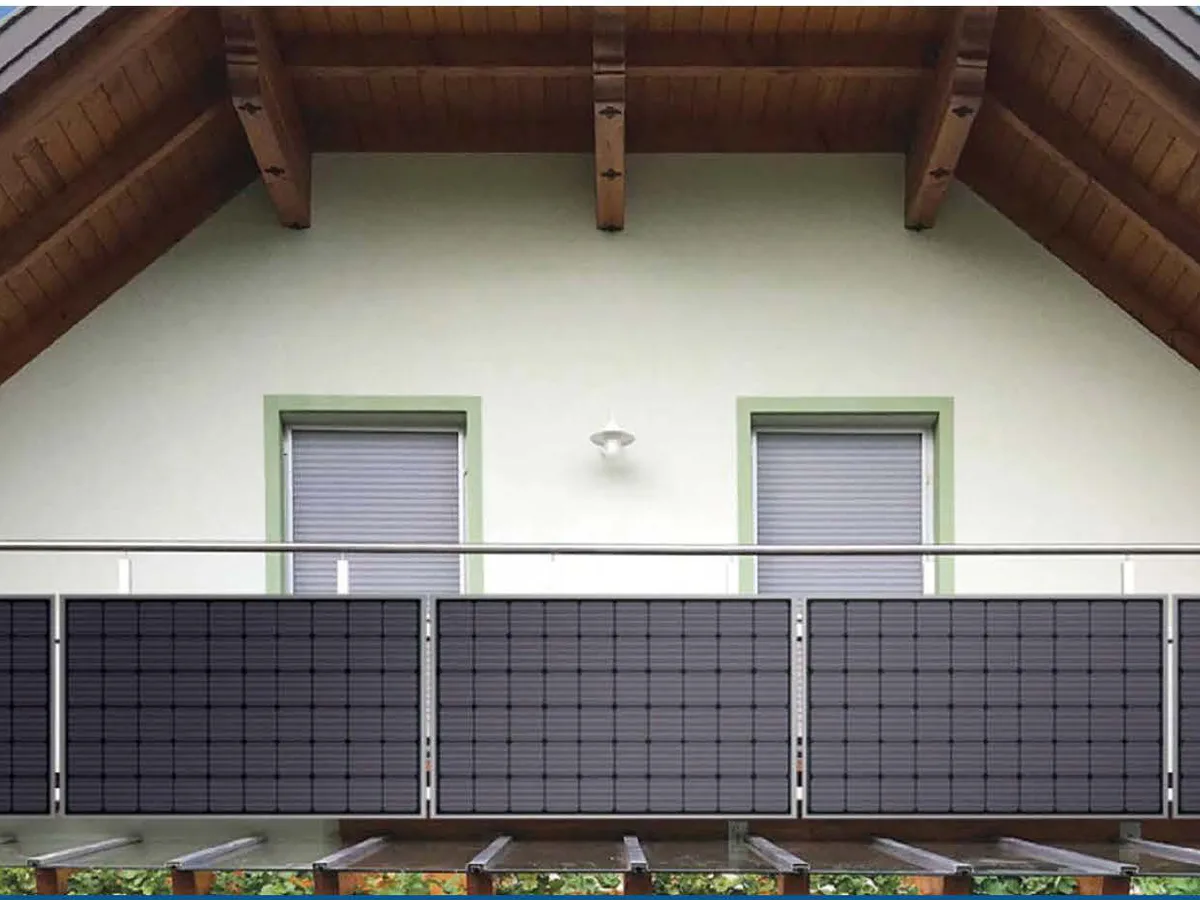
Not every solar system needs a roof, a scaffold or an electrician’s week of work. Across Germany, the UK and beyond, apartment dwellers are hanging solar panels from their balcony railings, plugging them into an ordinary wall socket, and watching their electricity meters slow down. Balcony solar – plug-and-play PV – has moved from curiosity to mainstream, and the economics explain why.
What a Balcony System Actually Is
A complete balcony solar set consists of two lightweight modules, adjustable mounting brackets, a micro inverter and a cable ending in a standard plug. The brackets hang the modules from the balcony railing – or mount them on a wall, a garden frame or a flat roof – and the micro inverter converts their DC output to household AC on the spot. Plug it into any socket and the power flows into your home’s circuits, where your appliances consume it before the meter sees grid power.
There is no rewiring, no distribution-board work and, in most European markets, nothing more than a simple registration with the grid operator. Installation is genuinely a one-person, one-hour job: our sets ship with every bracket, clamp and cable included, which is why they suit renters as much as homeowners. When you move, the system unplugs and moves with you.
The Numbers: Yield and Savings
A single module produces up to 450kWh per year in good Central European conditions – around 1.2kWh per day. That maps neatly onto the loads that run all day in a modern home: the refrigerator, the router, standby electronics, the washing machine and dishwasher on weekend cycles, and increasingly a home office.
At typical German household tariffs, that translates to savings of up to 100 euros per module per year. A two-module 800W set therefore saves a meaningful double-digit percentage of an apartment’s annual electricity bill – not by changing habits, but simply by covering the background load that runs anyway.
The adjustable-tilt bracket matters more than most buyers expect. A module vertical against a railing in December and optimally tilted in June can differ by a third in annual yield. The basic bracket sets a flexible angle by hand; the advanced model adds an electric telescopic rod with a controller, so the tilt adjusts remotely through the seasons without touching the hardware.
Why Europe, and Why Now
Three forces converged to make balcony solar a European phenomenon. Electricity prices rose sharply and stayed high, so even modest self-generation pays back quickly. Regulations simplified – Germany’s 800W plug-in threshold turned installation into a registration formality. And the hardware matured: all-black modules look discreet on a facade, micro inverters carry built-in grid protection and safety certification, and the whole kit now costs less than many annual electricity bills.
The aesthetic point deserves emphasis. Early adopters tolerated industrial-looking blue panels; today’s all-black modules read as a deliberate design element on a balcony railing, which is precisely why building managers and landlords increasingly approve them.
From Munich to Berlin: What Installations Look Like
Reference installations tell the practical story. In Munich, a family fitted a railing set on a south-facing balcony of a traditional house – the all-black modules sit flush against the balustrade below the bedroom windows. In Berlin, a garden-mounted set serves an apartment whose balcony faces the wrong way, proving the brackets work just as well on a lawn frame or a garage wall. In Birmingham, two installations show both extremes: modules hung neatly from a modern apartment railing, and a full-width array on a house balcony that turns the entire balustrade into a generator.
None of these households changed anything about how they live. The systems simply harvest daylight every day, and the savings accumulate month after month.
Durability: A 25-Year Appliance
A balcony set is a long-term asset, not a gadget. The modules carry a 25-year linear performance warranty – the same guarantee as full-size rooftop modules – and the frameless-railing hardware is corrosion-proof aluminium and stainless steel. With no moving parts in the basic configuration, maintenance is an occasional rinse with a hose. Over its warranted life, a two-module set will generate roughly twenty thousand kilowatt-hours; measured against its purchase price, that is some of the cheapest electricity a household can buy.
Is Balcony Solar Right for You?
The checklist is short: a balcony, wall or garden spot with reasonable sun exposure, a socket within cable reach, and a few hundred watts of daytime background consumption to soak up the output. South-facing is ideal, but east and west orientations still deliver most of the yield – and vertical mounting actually broadens generation into the morning and evening hours.
If you can answer those three questions with yes, the system pays for itself in a handful of years and then keeps paying for two decades more. Tell us your country, your balcony orientation and your typical tariff, and we will recommend a configuration – basic or adjustable-tilt – with a realistic annual yield estimate for your exact situation.