
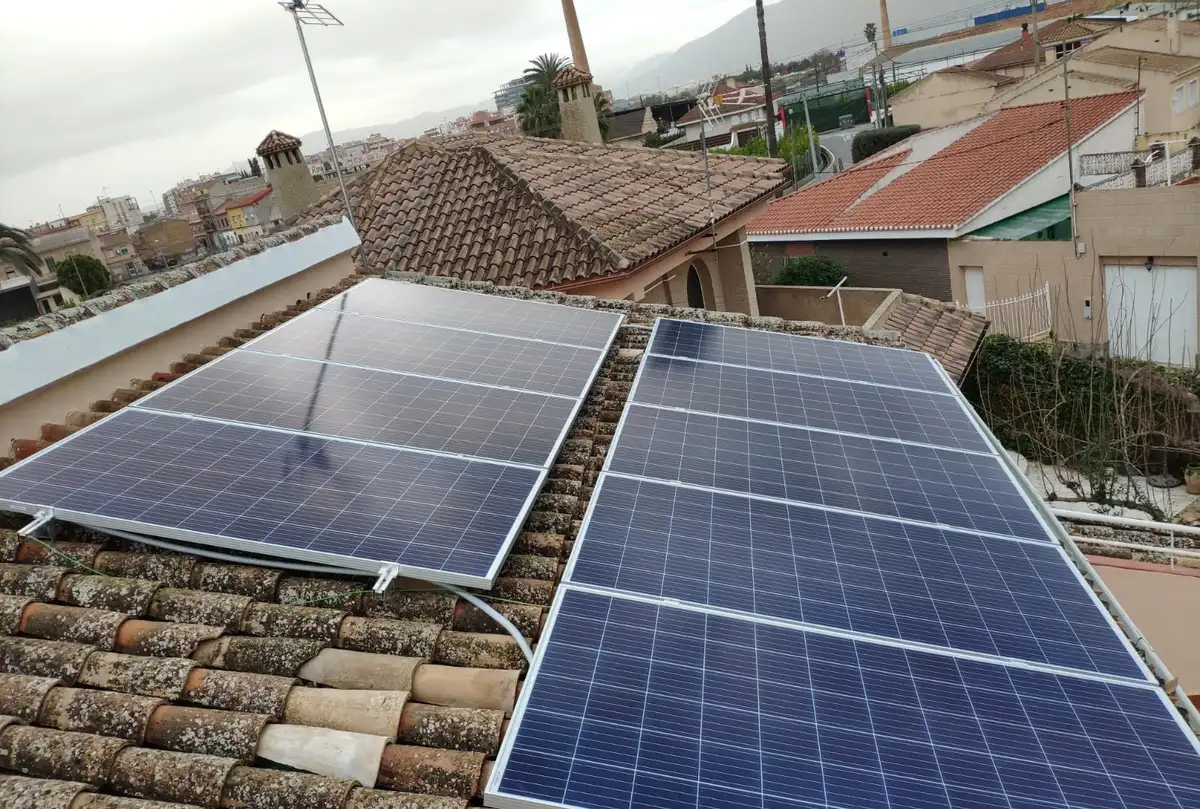
An off-grid solar system has one job: deliver reliable power every day of the year without the grid to back it up. Size it too small and you sit in the dark; size it too large and you overspend on panels and batteries that never earn their cost. This guide walks through the four-step sizing method our engineers use for real projects, from a mountain village pump station to a 120 kW factory in Angola.
Step 1: Calculate Your Daily Energy Consumption
Everything starts with the load list. Write down every appliance you plan to run, its power rating in watts, and how many hours per day it operates. Multiply watts by hours to get watt-hours (Wh) per day for each device, then add them up.
- Lighting: 10 LED bulbs x 10W x 5 hours = 500 Wh/day
- Refrigerator: 150W x 8 equivalent hours = 1,200 Wh/day
- TV and router: 100W x 6 hours = 600 Wh/day
- Water pump: 750W x 1.5 hours = 1,125 Wh/day
The example above totals about 3,400 Wh, or 3.4 kWh per day. Add a 20% safety margin for inverter losses, battery inefficiency and future loads, bringing the design target to roughly 4 kWh per day.
Two common mistakes: underestimating refrigerators and pumps (check the nameplate and duty cycle, not guesses) and ignoring surge currents. Motors can draw three to seven times their rated current at start-up, which matters in the next step.
Step 2: Size the Solar Array
Divide your daily energy requirement by the peak sun hours (PSH) at your location. PSH is not daylight hours – it is the equivalent number of hours per day at full 1000W/m² irradiance. Much of Africa and the Middle East enjoy 5-6 PSH, Southeast Asia and Central America typically see 4-5, and Northern Europe averages 2-3.
With a 4 kWh/day load and 5 PSH, the raw array size is 4 ÷ 5 = 0.8 kW. In practice we divide by a system efficiency factor of about 0.75 to account for panel temperature losses, dust, cable and charging losses: 0.8 ÷ 0.75 ≈ 1.1 kW. Choose panels accordingly – for example, two 550W or three 410W modules.
Season matters. If your rainy season halves solar output, either oversize the array by that factor or accept generator assist during the worst weeks. Off-grid design is always a conversation between budget and autonomy.
Step 3: Size the Battery Bank
Battery capacity determines how many days you can run without sunshine (autonomy) and how much of your daily load can shift to the evening. The formula is straightforward: daily energy (Wh) x autonomy days ÷ depth of discharge (DOD) ÷ system voltage.
For our 4 kWh/day load with one day of autonomy at 90% DOD on lithium: 4,000 x 1 ÷ 0.9 = roughly 4.5 kWh of storage – one wall-mounted 5 kWh LiFePO4 module fits perfectly. The same load on GEL batteries, where 50% DOD protects cycle life, needs 4,000 x 2 = 8 kWh, or about four 12V 200Ah blocks.
Tropical users with reliable sun often choose one day of autonomy; clinics and telecom sites typically specify two or three. Every extra day of autonomy is a real cost, so match it to the consequences of running out, not to anxiety.
Step 4: Choose the Inverter and Charge Controller
The inverter must handle two numbers: the continuous running load and the worst simultaneous surge. Add up everything that could run at once (in our example about 1,100W continuous), then allow for motor starting surges. A 3 kW pure sine wave inverter covers this load comfortably, and the built-in MPPT charge controller manages the solar input.
Voltage choice matters as systems grow. A 12V system is fine under about 1 kW. Beyond that, higher DC voltage (24V, 48V or, for industrial three-phase systems, 192-384V) keeps currents – and cable losses – manageable. This is why our 5-30 kW IGBT inverters use 48V to 192V battery buses, and the 5-100 kW three-phase series runs at 384V.
A Worked Example
A small farmhouse running 8 kWh/day in a 5.5 PSH region: array = 8 ÷ 5.5 ÷ 0.75 ≈ 1.9 kW (four 500W panels); battery = 8 kWh x 1.5 days at 90% DOD ≈ 13 kWh of lithium (a 15 kWh wall-mounted bank); inverter = 5 kW hybrid with 100A MPPT. Add mounting, cabling, protections and a combiner box, and the system is complete.
Common Sizing Mistakes
First, designing around peak load instead of daily energy – a 3 kW inverter on a 1 kWh/day battery bank fails at midnight. Second, ignoring temperature: panels lose power as they heat, which is why the -0.30%/K coefficient of N-type TOPCon modules matters in hot climates. Third, trusting nameplate sun-hours from a map without checking local weather data. And finally, mixing components from different suppliers whose voltage windows do not actually match.
Get a Second Pair of Eyes
Sizing is where most off-grid projects succeed or fail. If you send us your load list and location, our engineers will return a complete configuration – array, batteries, inverter and balance of system – with a wiring diagram, usually within 24 hours. It costs nothing to ask, and it is cheaper than replacing undersized batteries two years from now.